When Did You First Realize You Were an Entrepreneur?
I always love starting with this question, and Brad's answer gave us a fascinating look into how entrepreneurs are often made through experience, not just by starting their own thing.
"I was working for a billionaire doing acquisitions. We were buying entrepreneurial-led companies."
Brad wasn't running his own business yet, but he was deep in the world of entrepreneurship—watching successful (and struggling) business owners, learning what worked and what didn't.
His job? Find entrepreneurial businesses, buy them, and then go in as general manager to help scale them.
The challenge: Take a business from its current state and grow it 3-4x in five or six years.
Here's what Brad discovered about billionaire families:
"The kids think that they should live in the same manner as their parents. And so, like every 25 years, you have to produce exponentially more cash flow."
The solution? Buy entrepreneurial-led businesses that could grow exponentially and fund the lifestyle.
Brad would go into these businesses and install what he called "a more managerial operating system"—the structure, processes, and accountability that entrepreneurial businesses often lack in their early stages.
"We were buying entrepreneurial-led companies. They didn't tend to have a lot of structure to them. And we had a pretty strong point of view about how businesses should be run."
The first year was about building the foundation. After that, they'd bring in a CEO to run the growth while Brad moved on to the next acquisition.
The Shift: From Acquisitions to Management Consulting
In 2001, Brad made a decision that would shape the next two decades of his career.
"I kind of thought, you know, maybe there's a way to do this without flying to some other place every day."
He switched sides of the table—from working for the billionaire buyer to working directly with entrepreneurs.
From 2001 to 2019, Brad ran a management consulting business. He helped entrepreneurial companies install better systems, move from what he calls "flexible culture" to "accountable culture," and build the infrastructure needed to scale.
The pattern he saw: Entrepreneurial companies often have a very flexible culture where people wear lots of hats and cover for each other. That's great in the startup phase.
But when you want to hire experts—people who are really good at specific things—you need more accountability. You need to be able to reward them for the thing they're excellent at, not just for being a jack-of-all-trades.
Brad was really good at this work. He helped companies build job descriptions, performance management systems, and operational processes.
But he kept running into the same frustrating problem.
"I Need You to Fix My Team"
Here's how the conversation would always start:
Client: "Brad, I need you to help me fix my team. The team's all messed up. They're not good at what they do."
Brad (after years of hearing this): "So you want me to fix the team. The team that you hired and that you're managing and that you're leading. That team is the one that needs to be fixed?"
Client: "Yes! I don't want to do that. I want you to fix them."
Brad saw the problem clearly: No matter how good the systems were, if the leader didn't change, nothing would stick.
"I could do whatever I needed to do out there. I could build the job descriptions and the performance management and the systems. But if the leader themselves didn't find a new way to lead, then none of those changes were going to stick."
Brad encountered three common scenarios:
Scenario 1: The Reversion
He'd implement great systems. Everything would work beautifully. Then he'd step away, and the business would slowly revert back to the old way of doing things.
Why? The leader hadn't changed how they showed up.
Scenario 2: The Honest Team Member
Brad would be working with the team on implementing new systems. A team member would say something like:
"Yeah, Brad, but you know, the CEO, she's kind of like this."
Brad's response: "Great. Let's assume she's gonna keep being like that. That's unlikely that this process is gonna change that, right? How can we still help you to succeed in that environment?"
Sometimes the team member would say: "Well, if you're telling me that she's not gonna change, then I don't think I can be successful here."
And Brad would tell them the truth: "Great, then you should find another job because that's how it is here."
Scenario 3: The CEO Rejection
Brad would bring his recommendations back to the CEO. The CEO would look at the plan and say:
"No, no, no, no, not that. I don't want that at all. But I want you to fix the team."
Back to square one.
All three scenarios pointed to the same truth: The leader is the leverage point.
The Pivot to Coaching
Around 2017-2019, Brad started having conversations with his own coach about this frustrating pattern.
"I kept having this experience where the clients would hire me. And you know, in consulting, the kind of the implied contract is the client has a problem, the consultant is there to fix it."
But Brad realized he was trying to fix the wrong thing.
"I started saying, 'So you want me to fix the team, right? The team that you hired and that you're managing and that you're leading, like that team is the one that needs to be fixed. I think I can fix this more easily if it's just you and I talking than if I'm going out there doing all the things.'"
His coach pointed out something important: "Well, what you're talking about is coaching and not consulting."
The difference?
- Consulting: The consultant fixes the problem for you
- Coaching: The coach helps you become the leader who can solve the problem yourself
Brad made the shift in 2019. Same prospects, same client pool, just a different offer—coaching instead of consulting.
Then 2020 hit, and the transition accelerated. Consulting became harder to deliver during COVID, but coaching thrived.
The Calendar Audit: Where Your Time Actually Goes
One of Brad's most powerful tools is something deceptively simple: the calendar audit.
"I'm frequently doing is looking at a leader's calendar. And so in a session, I'll just say, hey, just share your calendar with me. Let's let's look at it together."
The first thing he almost always sees? Back-to-back meetings.
"Their calendar looks like a failing game of Tetris."
Brad has a process where he asks clients to think about who they're being on their best day versus their worst day.
Everyone knows who they are on their worst day. They don't want to be that person. They want to be their best self.
Then Brad asks: "What are the things that lead to more worst days?"
The answer, over and over: Back-to-back meetings.
"By three o'clock, if you've been in back-to-back meetings all day and you haven't peed and you haven't eaten and you haven't taken a break, you're hell on wheels. Like nothing good is gonna happen in that time."
Designing Your Ideal Calendar
Brad doesn't just identify the problem—he helps clients completely redesign their calendar.
The process:
First, acknowledge what creates your worst self (usually: no breaks, no thinking time, back-to-back meetings).
Second, design the calendar you want to have (not just accept the calendar you currently have).
Third, implement time blocking and theme days.
Theme Days: The Secret to Focused Work
Brad recommends organizing your week around themes:
- Monday: Marketing and outreach
- Tuesday: All your one-on-ones (so you're not context-switching all week)
- Wednesday-Thursday: Customer-facing time
- Friday: Review and planning
"Let's have all our one-to-ones on Tuesday so you're not doing having all the switching costs. Let's spend time with customers on Wednesday and Thursday. Friday might be a day for review and planning. Monday might be a day for marketing and outreach."
The resistance Brad always hears: "Well, I can't do this, Brad. You don't understand. I got client meetings."
Brad's response: "Yeah, you can do it. You have a hundred percent agency over your calendar. You can do whatever you want on your calendar."
What Happens When You Actually Do This
When entrepreneurs implement this calendar structure:
- They show up as their best selves more consistently
- They're more creative and engaging
- They get more actual work done
- They need fewer meetings (because focused work produces better decisions faster)
"When they're more in that best day self, they're more creative, they're more engaging, they get more stuff done. And so you need fewer meetings when you're actually focused and really getting to a decision rather than leaving a meeting without coming to a conclusion."
The Meetings Problem
I had to laugh when Brad said this, because it's so true:
"If we've got back-to-back meetings all day and we actually get to the end of the day and we've been in all these meetings, we look back and we're like, I didn't get anything done today."
The irony? You spent eight hours in meetings. But meetings aren't work—they're often where we talk about the work.
Brad's point: When you have focused time to actually think and execute, you need fewer meetings because you're making better decisions and actually getting things done.
The Entrepreneur's Responsibility: Delegation and Empowerment
One thing Brad emphasized that really resonated with me:
Your business will only grow as far as your ability to delegate and empower others.
If you're the one who has to approve everything, make every decision, and be involved in every client conversation—you're the ceiling on your business's growth.
"If the leader themselves didn't find a new way to lead, then none of those changes were going to stick."
That's the core truth Brad has learned after 20+ years working with entrepreneurial businesses.
You can hire the best team. You can install the best systems. You can follow all the right frameworks.
But if you don't change, nothing else will either.
Key Takeaways
Here's what I'm taking away from this conversation with Brad:
✅ Stop trying to "fix your team" – If your team isn't performing, look in the mirror first
✅ Audit your calendar ruthlessly – Back-to-back meetings make you "hell on wheels" by 3pm
✅ Design theme days – Batching similar work reduces context switching and increases effectiveness
✅ You have 100% agency over your calendar – Even if you don't believe it yet
✅ Process only works when leadership evolves – Systems don't fix leadership problems
✅ Coaching > Consulting for lasting change – You can't outsource your own growth as a leader
✅ Create space to think – If you're a leader, you're paid to think more than you're paid to do
Connect with Brad Farris
If you're ready to stop blaming your team and start becoming the leader your business actually needs, Brad's your guy.
Anchor Advisors: https://anchoradvisors.com/
About Today's Business Leaders
This show is about the real entrepreneurial journey—not the highlight reels you see on social media, but the actual challenges, failures, and breakthroughs that create lasting success.
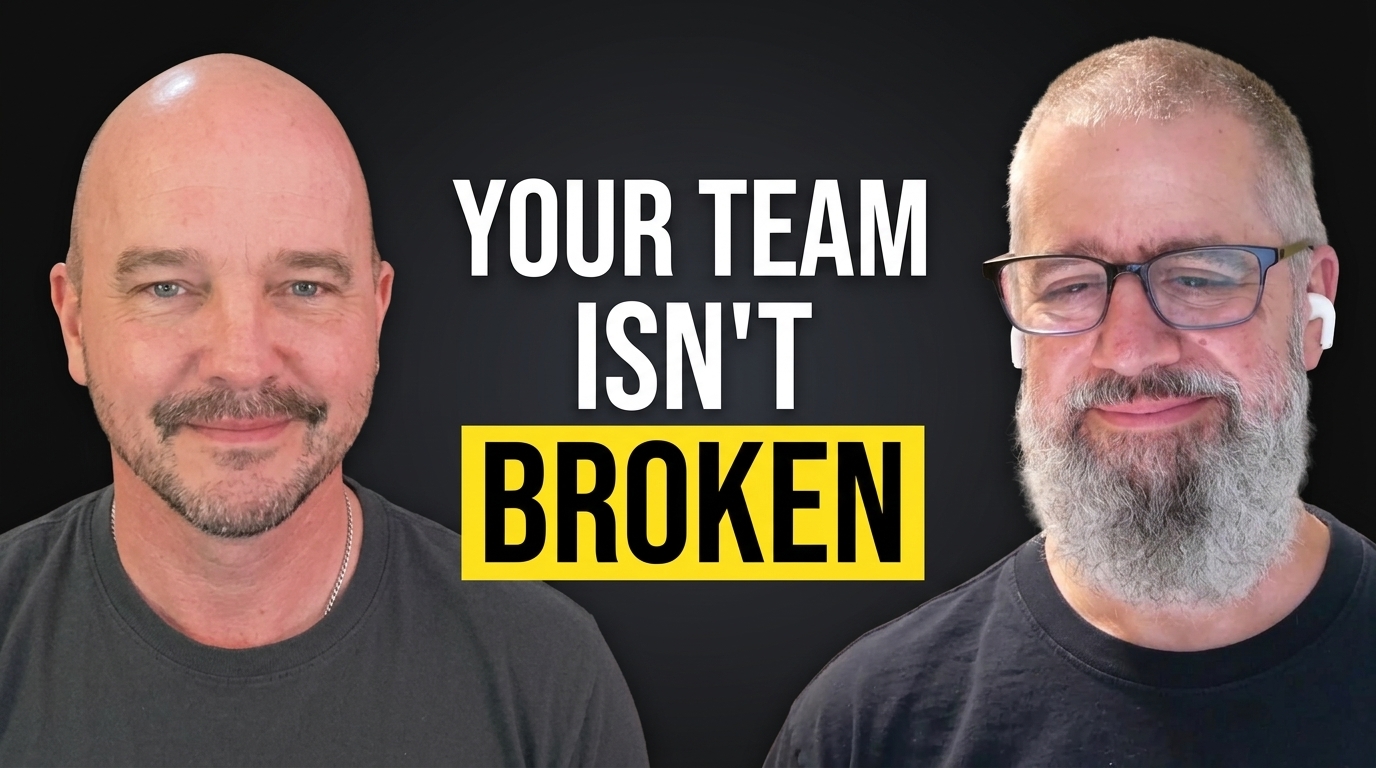
Hosted by Gabe Arnold, founder of Business Marketing Engine.
If this resonated with you, do me a favor and share it with another entrepreneur who's stuck blaming their team instead of looking in the mirror. We've all been there. The question is whether we're willing to do the work to change.
You've got this.
— Gabe