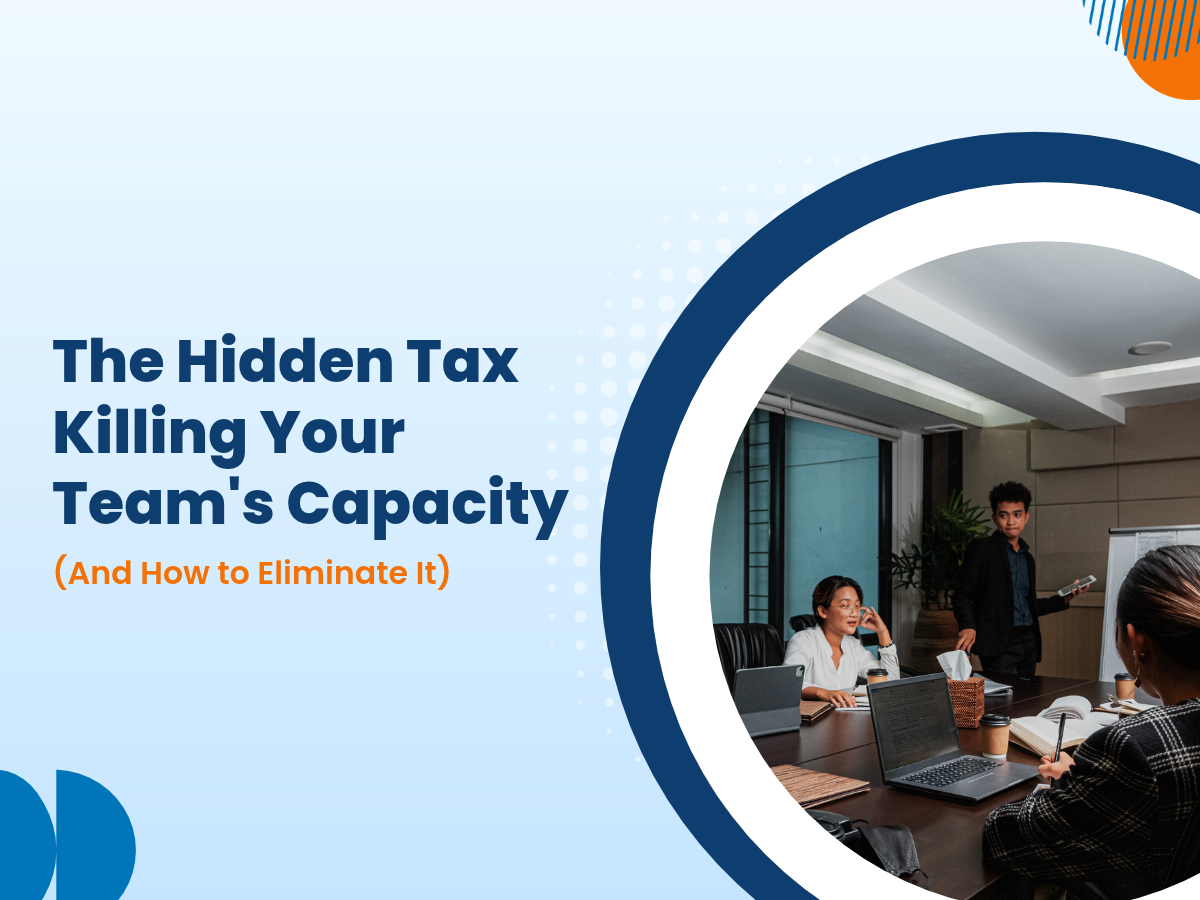
The Hidden Tax Killing Your Team's Capacity (And How to Eliminate It)
By Gabe Arnold ·
Quick answer
Context switching costs businesses time, productivity, and efficiency when employees repeatedly move between disconnected software tools. Unified operational systems can reduce manual work, minimize errors, and help teams recover lost capacity.
Key takeaways
- Context switching between disconnected software tools costs businesses time, energy, and productivity.
- Scattered information and manual data transfers increase errors and slow down decision-making.
- Unified operational systems can reduce unnecessary tool switching and manual work.
- Mapping workflows and identifying friction points are essential before building integrated systems.
- The article's design-build company example reports 20–30% time savings after consolidating its systems.
Most business owners can tell you exactly what they're spending on software each month.
$50 for the CRM. $100 for project management. $80 for accounting software. $30 for the scheduling tool. Maybe another $200 across various other subscriptions that "we need to run the business."
What they can't tell you is what those disconnected tools are actually costing them.
Not just the cost of subscription fees. The real cost: the context-switching tax their team pays every single day.
The Company That Had Everything, Except Integration

A design-build company reached out to us earlier this year. They were doing well by most measures—custom home builds, high-end kitchen remodels, additions. Good clients, solid revenue, experienced team.
But when we started asking about their operational workflow, a familiar pattern showed up.
Their project manager would start the day in their project management tool, checking schedules and updating task lists. Then they'd switch to email to communicate with clients. Then over to their accounting software to check what needed to be billed. Then into a spreadsheet to update cash flow projections. Then back to the project management tool. Then back to email.
Their bookkeeper had it even worse. To create a basic financial report, they had to log into the project management system to see what was scheduled to be billed, switch to the accounting software to pull accounts receivable, open a spreadsheet to calculate cash flow projections, and then manually compile everything into a report for the ownership team.
This was happening multiple times per week, sometimes daily during busy periods.
The team wasn't struggling because they lacked skills or work ethic. They were exhausted from managing their tools instead of using their tools to do great work.
What Context-Switching Actually Costs You
Here's what most business owners don't realize: every time your brain switches from one task or environment to another, there's a cognitive cost.
It's not just the 10 seconds it takes to close one tab and open another. It's the mental energy required to reorient yourself in the new environment, remember where you left off, and get back into flow state.
Research shows it can take 15-25 minutes to fully regain deep focus after a context switch. If your team is switching tools 10-15 times per day, they're losing hours of productive capacity just trying to refocus.
But the cost goes beyond time:
Decision fatigue compounds. Every tool switch requires micro-decisions: Where do I find this? What was I looking for? Did I already update that? Which system has the most current data? By noon, your team's decision-making capacity is already depleted, not from strategic work, but from navigating their own systems.
Errors multiply. When information lives in five different places, something will eventually get copied wrong, updated in one place but not another, or simply forgotten. Manual data transfer between systems isn't just slow—it's unreliable.
Energy drains invisibly. Your team can't point to "context-switching" as the reason they're tired at the end of the day. They just know they worked hard but somehow didn't accomplish as much as they should have.
New hires take longer to onboard. Instead of learning your business processes, new team members spend weeks just learning which tool does what and when to use each one. Complexity becomes a barrier to growth.
The Create Phase: Building Systems That Work With You, Not Against You

This is where most agencies and consultants stop. They'll audit your tools, recommend you consolidate, maybe suggest a different software platform.
We take a different approach.
After we walked through the design-build company's entire operational flow—from lead capture to project delivery to final billing—we didn't just recommend they switch tools. We built them a unified operational system designed specifically for how their business actually works.
It’s one platform where project schedules, task management, client communication, and financial reporting all live together.
Now when their project manager opens the system in the morning, everything they need is right there. Project status, client communications, upcoming deadlines, budget tracking—all in one view.
When their bookkeeper needs to create financial reports, they don't switch tools at all. The data flows automatically from operations into financial reporting. What used to take hours now takes minutes.
Here's what changed:
20-30% time savings across the team. Not from working faster, but from eliminating the friction that was slowing them down in the first place.
Capacity to take on more projects without hiring. They're currently handling more project volume with the same team size because that team has their energy back.
Dramatic reduction in software costs. They went from six separate subscriptions to one unified system, saving thousands annually.
Faster, better decision-making. When all the data lives in one place, leadership can see the full picture instantly. No more waiting for someone to compile reports from multiple sources.
But the most significant change is that the team's morale improved dramatically. They stopped feeling like they were constantly playing catch-up and started feeling in control of their work again.
The Bridge Between Discovery and Creation
This is a perfect example of why the Discover phase of our DCAR Marketing Engine can't be skipped.
We didn't walk into that design-build company with a pre-built solution and try to make them fit into it. That's the old way of doing things, and it's why most "solutions" create as many problems as they solve.
Instead, we started with discovery:
What does your actual workflow look like from start to finish?
Where do team members get stuck or frustrated?
What information do you need, when do you need it, and in what format?
What's working well that we need to preserve?
What's broken that we need to fix?
Only after we fully understood their unique operational reality did we move into the Create phase and start building.
This is what systematic, compounding growth looks like. You can't create effective solutions without first discovering the real problem. And you can't scale a business built on scattered, disconnected systems—no matter how good your marketing is.
What To Do If Your Team Is Drowning in Tools

If this story sounds familiar—if your team is switching between multiple platforms just to complete basic tasks—here's where to start:
Map your actual workflow. Document how information actually flows through your business from start to finish, noting every tool switch and manual handoff.
Identify the friction points. Where do people get stuck? Where does information get lost? Where are errors most common? Where does the most manual copying and pasting happen?
Ask your team. They know exactly where the pain points are. Create space for honest feedback about what's actually slowing them down. The answers might surprise you.
Calculate the real cost. If context-switching is costing your team 20-30% of their capacity, what does that translate to in salary dollars? What would it be worth to get that capacity back without hiring?
Then ask yourself: is the complexity serving your business, or is your business serving the complexity?
Ready to Audit Your Operational Systems?
We help businesses eliminate the context-switching tax by building unified systems designed around how they actually work, not how software companies think they should work.
Schedule a complimentary 30-Minute Marketing Strategy Assessment. We'll map your current operational workflow, identify where your team is losing capacity to tool-switching, and show you exactly what a unified system could look like for your business.